
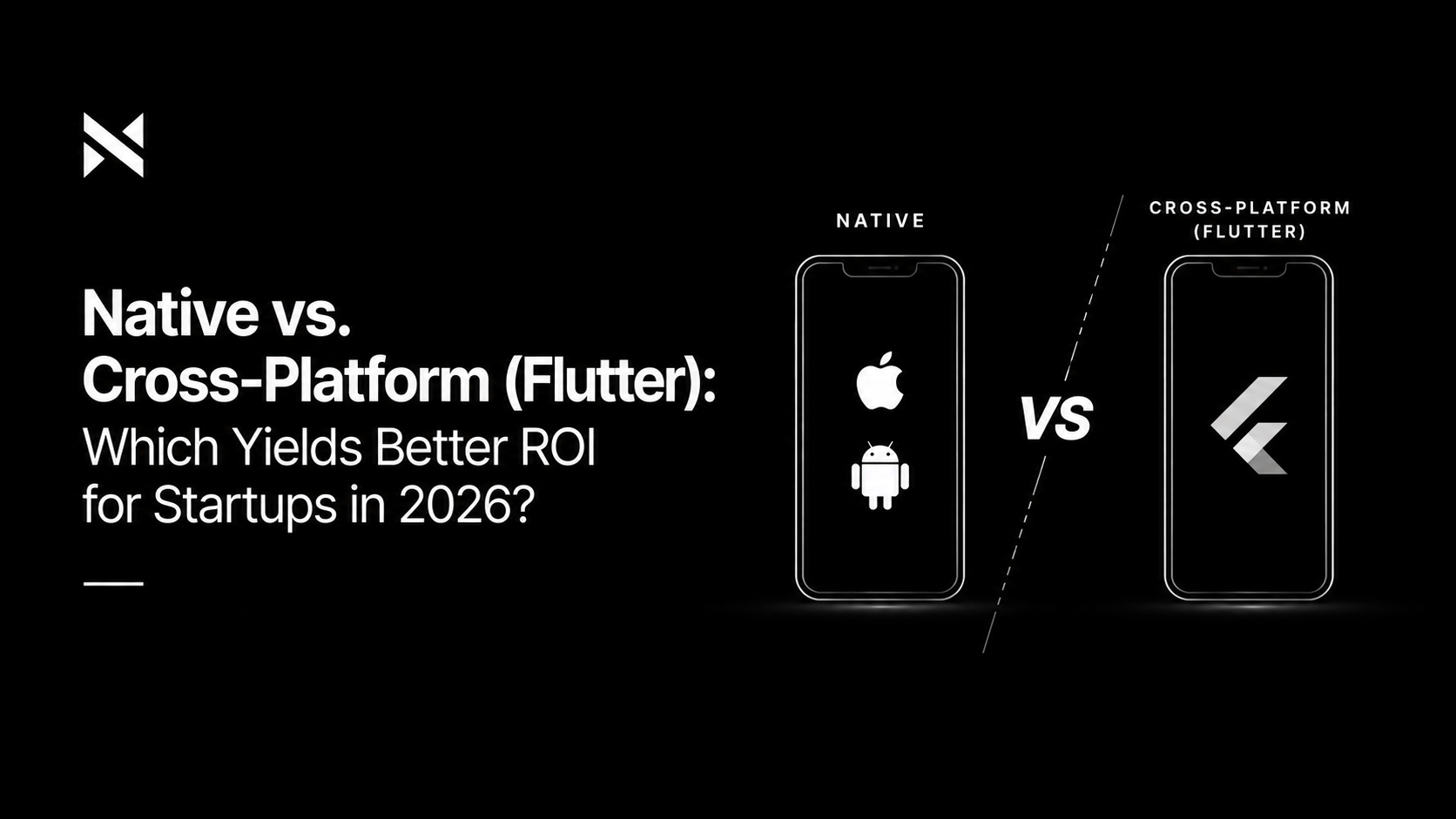
Every startup founder faces the same technical crossroad: “Should I build a Native app or a Cross-Platform app?”
Five years ago, the answer was simple: If you wanted quality, you went Native. If you were broke, you went Cross-Platform. But in 2026, the landscape has completely shifted.
With the maturity of frameworks like Google’s Flutter, the gap between “performance” and “affordability” has closed. Today, big players like BMW, Alibaba, and Google Pay run on Flutter.
For a startup, this decision isn’t just about code—it’s about Burn Rate and Time-to-Market. Choosing the wrong stack can double your development costs and delay your launch by months.
In this guide, we compare Native (Swift/Kotlin) vs. Cross-Platform (Flutter) to see which one actually delivers a better Return on Investment (ROI).
1. The Fundamental Difference
To understand the cost, you have to understand the build.
-
- Native Development: You build two completely separate apps. You need one team writing Swift for iOS (iPhones) and another team writing Kotlin for Android.
-
- Result: Two codebases to write, test, and maintain.
-
- Native Development: You build two completely separate apps. You need one team writing Swift for iOS (iPhones) and another team writing Kotlin for Android.
-
- Cross-Platform (Flutter): You write one single codebase (using the Dart language). This code is then compiled to run natively on both iOS and Android.
-
- Result: Write once, deploy everywhere.
-
- Cross-Platform (Flutter): You write one single codebase (using the Dart language). This code is then compiled to run natively on both iOS and Android.
2. The Cost Comparison (ROI Analysis)
This is where the math gets interesting for business owners.
-
- Development Hours: Because Flutter allows developers to reuse up to 90% of the code across platforms, development time is significantly reduced.
-
- Native Project: ~1,000 hours (500 iOS + 500 Android).
-
- Flutter Project: ~600 hours (Total).
-
- Development Hours: Because Flutter allows developers to reuse up to 90% of the code across platforms, development time is significantly reduced.
-
- The Savings: By choosing Flutter, startups typically save 30% to 40% on initial development costs. For a bootstrapped company, saving $15,000 – $20,000 upfront can be the difference between surviving or folding.
Want to see how these hours translate to dollars? Check our [Ultimate Guide to App Development Costs in 2026].
3. “But What About Performance?” (The 2026 Reality)
A common myth is that Cross-Platform apps are slow or “laggy.”
-
- The Old Days: This was true for older frameworks like Ionic or PhoneGap, which were basically websites wrapped in an app shell.
-
- The Flutter Era: Flutter is different. It compiles directly to native machine code. It renders graphics at 60-120 frames per second (FPS), which is indistinguishable from a Native app to the human eye.
Unless you are building a high-fidelity 3D mobile game (like PUBG or Call of Duty), your users will never know the difference.
4. Time-to-Market: The Speed Advantage
In the startup world, speed is the only currency that matters.
-
- Unified Teams: With Flutter, you don’t need to coordinate two separate teams. If you want to change the color of a button, you change it once, and it updates on both iOS and Android instantly.
-
- Faster Testing: Quality Assurance (QA) is faster because the logic is the same across devices.
-
- Launch Date: You can typically launch a Flutter MVP (Minimum Viable Product) in 3 months, compared to 5-6 months for Native.
5. When Should You Actually Go Native?
At Noviindus, we value honesty. Flutter is great, but it’s not for everyone. You should stick to Native development if:
-
- Deep Hardware Access: Your app relies heavily on complex Bluetooth connections to external hardware (like medical devices).
-
- Heavy AR/VR: You are building an Augmented Reality app that pushes the GPU to the limit.
-
- OS-Specific Features: You need a feature that only exists on the latest iPhone and hasn’t been released for Android yet.
Conclusion
For 90% of E-commerce, Service, Booking, and Enterprise apps, Flutter is the clear winner in 2026. It offers the performance of Native with the development speed of the web.
Don’t let “purist” developers spend your budget on unnecessary duplicate code. Build smart.
Ready to validate your app idea? Get a Free Flutter Consultation